
What Happened to the Bones of the American Bison?
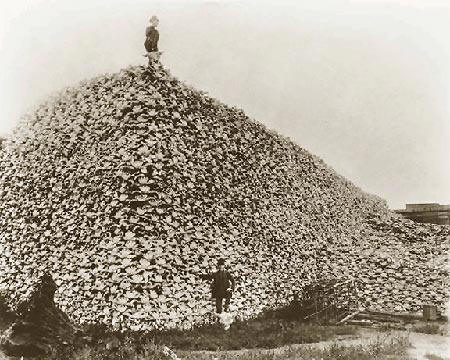
Two men stand with a minimum of 15,00 bison skulls (circa late 1800s). Photo credit: National Park Service
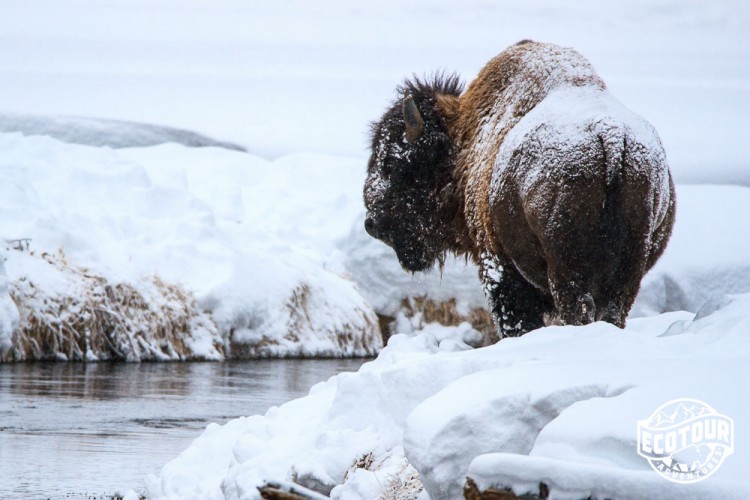
Today, seeing a herd of American bison is one of the defining experiences of exploring the American West. In places like Yellowstone National Park and Grand Teton National Park, bison still move across open valleys and through rivers much as they have for thousands of years.
It can be easy to look at a herd today and forget just how close these animals came to disappearing. In the early 19th century, tens of millions of bison roamed North America. By the late 1880s, fewer than 1,000 remained in the wild. The story of their near-eradication is one of the darkest chapters in American history. Bison were killed for their hides and tongues, for sport, and as part of a broader campaign that sought to undermine Indigenous communities whose cultures, livelihoods, and food systems were deeply connected to the animals. The destruction of the bison was, in many ways, also an assault on the people who depended upon them.
The bones left behind
A recent article in JSTOR Daily, What Happened to the Bones of the American Bison?, explores a lesser-known chapter in the history of the bison slaughter: the bone trade that followed.
The scale of the killing was so enormous that the landscape was littered with bison carcasses. As the carcasses consumed by scavengers and the animals' bodies decomposed, their bones were left to bleach in the prairie sun. Then people began collecting them.
The late 19th-century “bone hunters” scoured the Great Plains, gathering the remains of bison and hauling them to markets and factories. The bones became raw material for an emerging industrial economy. They were ground into bone ash and used as fertilizer. They were burned to produce bone black, which was used as a dye and in the filtration of sugar. Other parts of the animals could be turned into glue. Some bones were even fashioned into everyday objects such as buttons, knife handles, fans, and umbrella ribs—cheap alternatives to ivory before the widespread use of plastic.
According to the research highlighted by JSTOR Daily, bones from roughly 100 complete bison skeletons could make up a ton of material. Depending on market conditions, a bone hunter might earn several dollars for that ton—a reflection of both the immense scale of the industry and the grueling work required to collect it.
The bone trade lasted less than two decades. And because it consumed the very remains it depended upon, it eventually left remarkably little physical evidence behind.
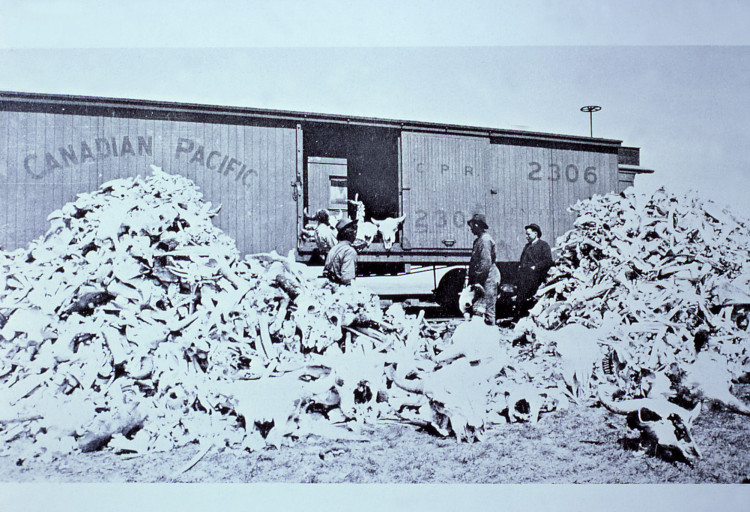
Photo credit: National Park Service
A history that is still with us
The history of the bison bone trade is more than a strange footnote to the American West. It offers another perspective on the enormous ecological and cultural consequences of the bison's near-extinction. The loss of bison changed entire ecosystems, disrupted Indigenous lifeways and economies, and transformed the Great Plains. And yet, bison survived.
Today, the American bison is a powerful symbol of conservation success. Yellowstone is home to the largest continuously free-ranging bison population in North America, and the animals remain an integral part of the Greater Yellowstone Ecosystem. Sometimes, it can be hard to fathom that their story came remarkably close to ending.
The return of the bison is not a simple story of restoration. The animals that roam Yellowstone today live in a world profoundly shaped by human actions, from historic slaughter to modern wildlife management and land-use decisions.
But their presence is also a reminder of what conservation can accomplish. Bison are ecosystem engineers. Their grazing helps shape grasslands, their movements redistribute nutrients, and their wallowing creates small disturbances that can influence plant communities. They are also part of a larger web of relationships that includes predators, scavengers, birds, insects, and countless other species.
Their recovery matters because the presence of bison matters—not only as an emblem of the American West, but as a living part of a functioning ecosystem. The herd standing in front of us is in Jackson because the species endured an era of extraordinary destruction. The bones that once covered the Great Plains were gathered, processed, and sold, leaving little behind, but the animals themselves persisted.
That is why conservation matters. It is not simply about protecting the wildlife we have today. It is about ensuring that future generations can experience the same sense of wonder and wildness that we are fortunate enough to witness now.
Want to learn more about the history, ecology, and wildlife of the Greater Yellowstone Ecosystem? Join EcoTour Adventures on a wildlife tour through Yellowstone or Grand Teton and discover the stories behind the landscapes and animals that make this place so extraordinary.